


One identity. Infinite possibilities.
Verification, storage, intelligence, communication, finance, and social, all powered by a single identity that only you control. The LIFE Stack reads foundation to surface: the rules the system obeys sit at layer one, and the surfaces people use sit at layer twelve. Value here begins with a living person, not an account assigned to you.
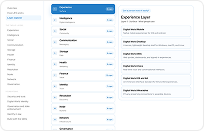
Each layer answers one question about whether a person stays in control. Open the layer explorer to see the capabilities inside any layer, or scroll to a layer to read its full set. Every capability is a Digital World standard, service, or tech, described by what it does for you rather than by how it is built.
How LIFE works, secure at every step
End to end encrypted from the moment you interact to the moment the network verifies it.
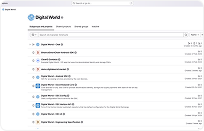
Layer explorer
Select any layer to see its primary question and the capabilities it provides.
The twelve layers in full
Every capability below is presented as a Digital World standard or service. Repositories and SDKs live in the Digital World organization on GitLab.
Security and trust
Six principles keep you in control. They are design constraints, not slogans.
Digital World Identity
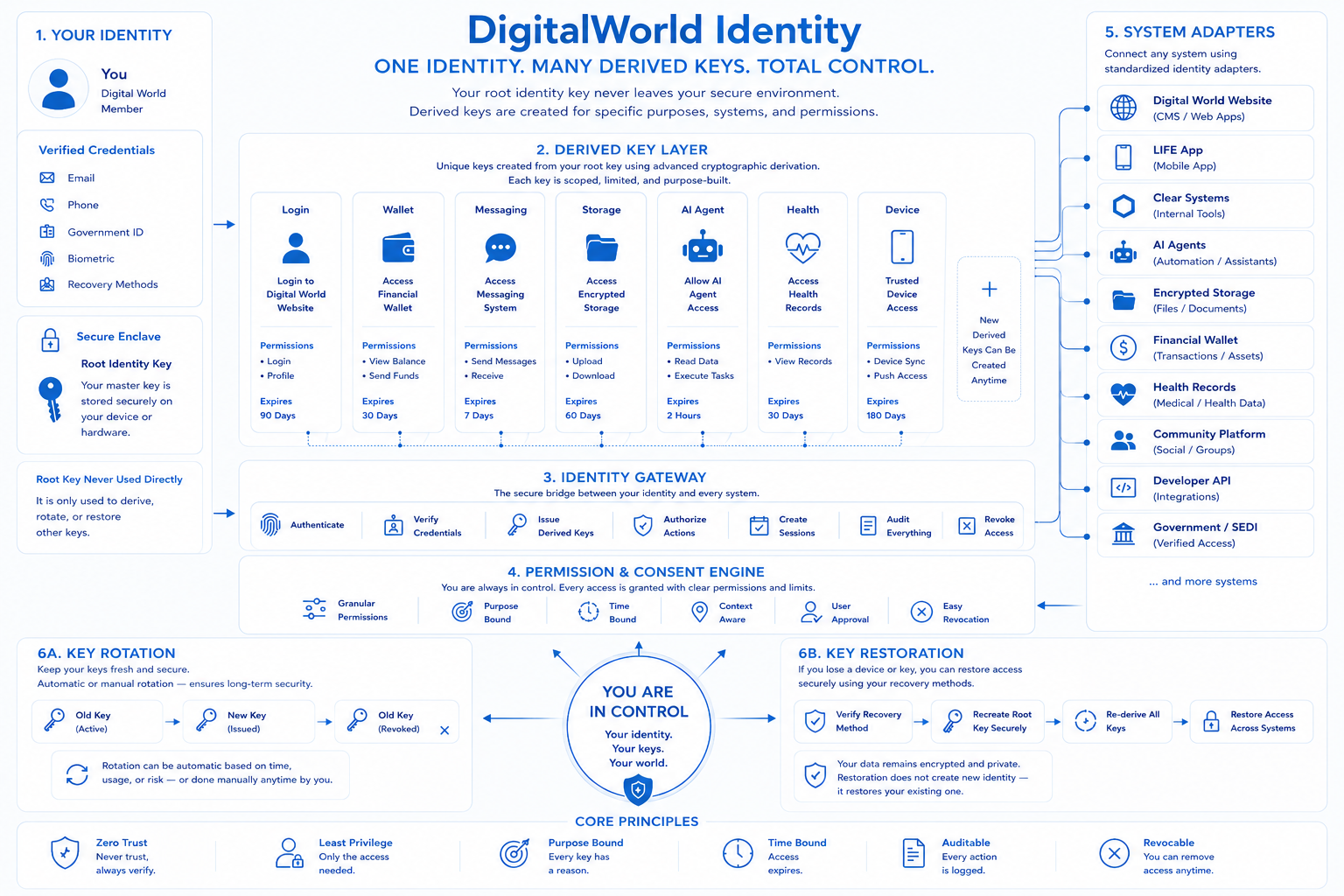
One identity. Many derived keys. Total control. Your root identity key never leaves your secure environment. Every service gets its own scoped, time-limited, revocable key, so you grant exactly the access a moment needs and nothing more.
 View full
Even a Digital Intelligence agent receives only a narrow, short-lived derived key (for example, read data and execute tasks for two hours). It acts with your authority and never holds your root key. Build these flows with the open SDKs.
Governance and state endorsement
Digital World provides the global identity framework. State-endorsed identity is one profile inside it. A state can recognize your credentials without owning the person or the network.
The core stays human-first and global. Profiles adapt to states, industries, and institutions. Annexes hold the compliance and relying-party rules. A state-endorsed profile can align with Utah Code Title 63A, Chapter 20, while keeping the keys, the data, and the final decision with you.
Issuer, holder, and verifier stay separate
Proof points: pairwise identifiers, verifiable credentials, private storage, selective disclosure, user-held keys, consent receipts, and audit trails. Open standards, independent validators, transparent rules, and state endorsement without state ownership. Not a government account. Not a surveillance ID. Not a single database.
Identity in law: Digital World first, regions second
Digital World comes first. DWDI is the global framework that defines the rights, and it stands on its own with no government required. A region can then endorse those same rights in its own law, as an optional profile that plugs into the global core. Utah is the first region to do it. Others follow the same pattern.
Digital World (DWDI)
The constant layer. Rights and rules are set by open, community-governed instruments on a one human, one vote basis, with no single issuer, database, or verifier. This holds everywhere, with or without any state.
- Declaration of Unity: the founding statement of principles, rights, and responsibilities.
- Council Legislation: Acts created and ratified by the Digital World Councils.
- Core, profiles, and annexes: the human-first global core, plus adapters for states, industries, and institutions.
- Open standards: publicly available, free of licensing fees and patent restrictions.
Regional profiles, second
A region adopts Digital World by mapping the global core into its own law. The rights never change. Only the local endorsement, currency, and relying-party rules adapt. Utah is the first to publish a profile.
State of Utah
Utah enacted the State-Endorsed Digital Identity Program in the 2026 General Session, codified as Utah Code Title 63A, Chapter 20.
- S.B. 275 (2026 General Session), 2nd Substitute: State-Endorsed Digital Identity Program Amendments.
- Title 63A, Chapter 20: effective May 6, 2026, housed in the Department of Government Operations.
- Issuance and revocation infrastructure in a state-controlled data center inside the state.
- The implementation guide carries the technical detail across its nine parts.
Your region next
Any nation, state, tribe, city, or institution can publish its own profile that endorses the same Digital World rights. The global core stays the constant; the region supplies only local endorsement and rules.
- Start from the Digital World core and its open standards.
- Map each global right to a local statute or rule, as Utah did.
- Keep issuer, holder, and verifier separate, with the keys held by the person.
The Digital Identity Bill of Rights
These are Digital World rights first. Utah was the first region to write them into statute, where Utah Code 63A-20-101 opens the chapter with a bill of rights that reads like the Digital World promise in law. In plain language, it guarantees that:
- Your identity is innate, fundamental, and inalienable, independent of the state.
- You have the right to manage and control your digital identity to protect your privacy.
- You may choose, receive, and use a state-endorsed form of identity assertion.
- You cannot be compelled to use a digital form in place of a physical one.
- You have a right to endorsement on objective, uniform standards, not arbitrarily withheld or revoked.
- You have a right to clear, legislature-set standards for the whole identity lifecycle.
- You have a right to transparency: to read and review the standards and technical specifications.
- You choose which identity attributes your digital identity discloses.
- You keep access to any service you are entitled to, whatever lawful means of identity you choose.
- You have a right to be free from surveillance, profiling, tracking, or persistent monitoring by the state.
- You cannot be required to surrender your device to present your identity.
How the first region implements the standard
Utah's profile does more than define a credential. It shows how a region can carry the Digital World standard into a complete, rights-first program:
The constant and the variable
The Digital World principle on the left is the constant, the same in every region. The provision on the right is the variable, shown here as Utah, the first region to map it into law. Another region would fill this column with its own statutes.
For most of the digital era, proving who you are has meant being tracked, profiled, and locked into someone else's database. Digital World inverts that, globally and first. It puts the keys, the data, and the final decision with the person, and binds every other party to consent, minimization, transparency, and a duty of loyalty. Utah is the first region to write that promise into law, and others can follow the same pattern. The result is dignity by design: proof without surveillance, participation without coercion, and services without platform capture. When a government can endorse your credentials without owning you, identity stops being a leash and becomes a tool you hold. That is the practical shape of human freedom in a digital world.
Build with the SDKs
Every layer is open and interoperable. Each SDK connects to the same Digital World Network endpoints for transaction building, account management, Gateway REST calls, and RPC access. See the full developer docs for guides and references.
Network details
Every SDK ships pre-configured with these network details.
https://dex.digitalworld.globalDigital World Network ; June 2021Choose your SDK
Pick a language and start building. The JavaScript SDK is live; the rest are on the way.
Market API
A read-only REST API for Digital World Market data. Retrieve verified assets, issuers, names, and logos. Open to anyone, no API key required.
APIMarket APIsdk.digitalworld.market/api